Archive for category Classic Literature
Thoughts on Paradise Lost
Posted by lberry in Classic Literature on August 31, 2012
 Paradise Lost is not for the fainthearted. John Milton was not messing around with simplistic approaches to his project when he decided to jump in and dictate his thoughts about the fall of man. This is meaty reading that requires alert attention and a willingness to unravel some archaic language use. Like many classics, there are numerous volumes available to read and all are not equal in quality, or similar in approach.
The copy I read is hosted at Dartmouth University. You can find it here if you’d like to get started now. Plan on spending the entire month ’cause it’s slow-going – or at least it was for me. Oversaturation. I gather from the extensive nature of the Dartmouth website that Milton’s works are a favored sport amongst the student body or at the least, someone’s specialty in the English department. Someone with power. That or the university enjoys torturing students with old literary escapades.
I thought I’d read Paradise Lost a lifetime ago in secondary school but after sitting through all TWELVE books of the entire read, I’m forced to conclude my previous experience involved an excerpt. I look back on that sample with increased fondness now. It’s not as bad as it sounds, really. This is one whopping big poem and so it’s broken into smaller chunks (Books 1 through 12), for better management, one would suppose.
The original work was published in 1667, so perhaps the format has something to do with the penchant of publishing to produce small readable volumes in a serialized fashion at the time. I dunno. Doesn’t really matter. It’s a whopping BIG poem, did I mention that?
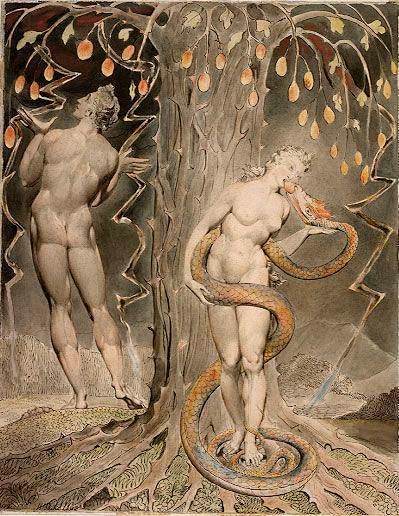
William Blake, Temptation and Fall of Eve
Epic poetry deserves respect. It requires dedication and hard labor to produce in quantity without forced lineation and ridiculous convoluted language-use. Milton is adept with the form and obviously well-versed in his subject matter. Regardless of which position you find yourself in regarding his arguments, it’s a wonderfully rich journey.
I read the whole darn thing but don’t quiz me on it because there were parts where my eyes crossed, my mind went numb, and I may have forgotten to blink for long periods of time. The verse has a cumulative effect somewhat like a snowball rushing down the side of a mountain, picking up speed and debris until the reader is swallowed by an avalanche of linguistic imagery. Great word usage. Awesomely overwhelming deluge of Biblical content. If you enjoy ecclesiastical debate and dissecting prose, well this is a volume you’ll be wanting to check out for yourself.
Most classic literature (especially those works that appear regularly in educational curriculum), often have a wide range of support materials available to assist the curious in better understanding context. I think Paradise Lost may own a majority of market share when it comes to this sort of stuff. You may be wondering, like what kind of stuff? Well…like this comprehensive everything-you-need-to-know site, and this companion exhibit featuring 17th century culture, and this study guide which includes quizzes and tests, and these cliffnotes…and this book-by-book plot summary and analysis…and this novel-guide in simple English. And since Dartmouth doesn’t have a lock on academics obsessed with this particular work, don’t forget these study questions from Stanford University. Or this critical reading by a real critic.

Gustave Dore, The Heavenly Host
See what I mean?
These people are bonkers for Milton. It’s not that Paradise Lost isn’t interesting. It is. It is also a demanding read that requires solid background knowledge of culture, place, theology, timely context, and politics. One of the reasons there are such a plethora of support materials is because many students and members of the reading public lack comprehensive grasp of most of those necessities, myself included.
The language is beautiful. The poem is particularly lovely read aloud and a reading partner is a wonderful addition to the endeavor. Make certain you decipher the “argument” at the beginning of each book because that’s what the content is a response to…and it helps to gather a sense of why Milton undertakes his discussion with such fervor.
If you haven’t tried the full length experience, give it a shot. It isn’t for everyone, but it’s worth trying. When was the last time you read an epic poem? Twitter doesn’t count. Not even if you string all those tweets together. The Paradise Lost archive is an excellent place to start, a sort of one-stop-shopping for all things Miltonesque.
Let me know how it goes. We can commiserate.
-
You are currently browsing the archives for the Classic Literature category.


 Lesann Berry